Nurturing Talent and Integrity: Ann Miura-Ko on Mentorship and Entrepreneurship Education
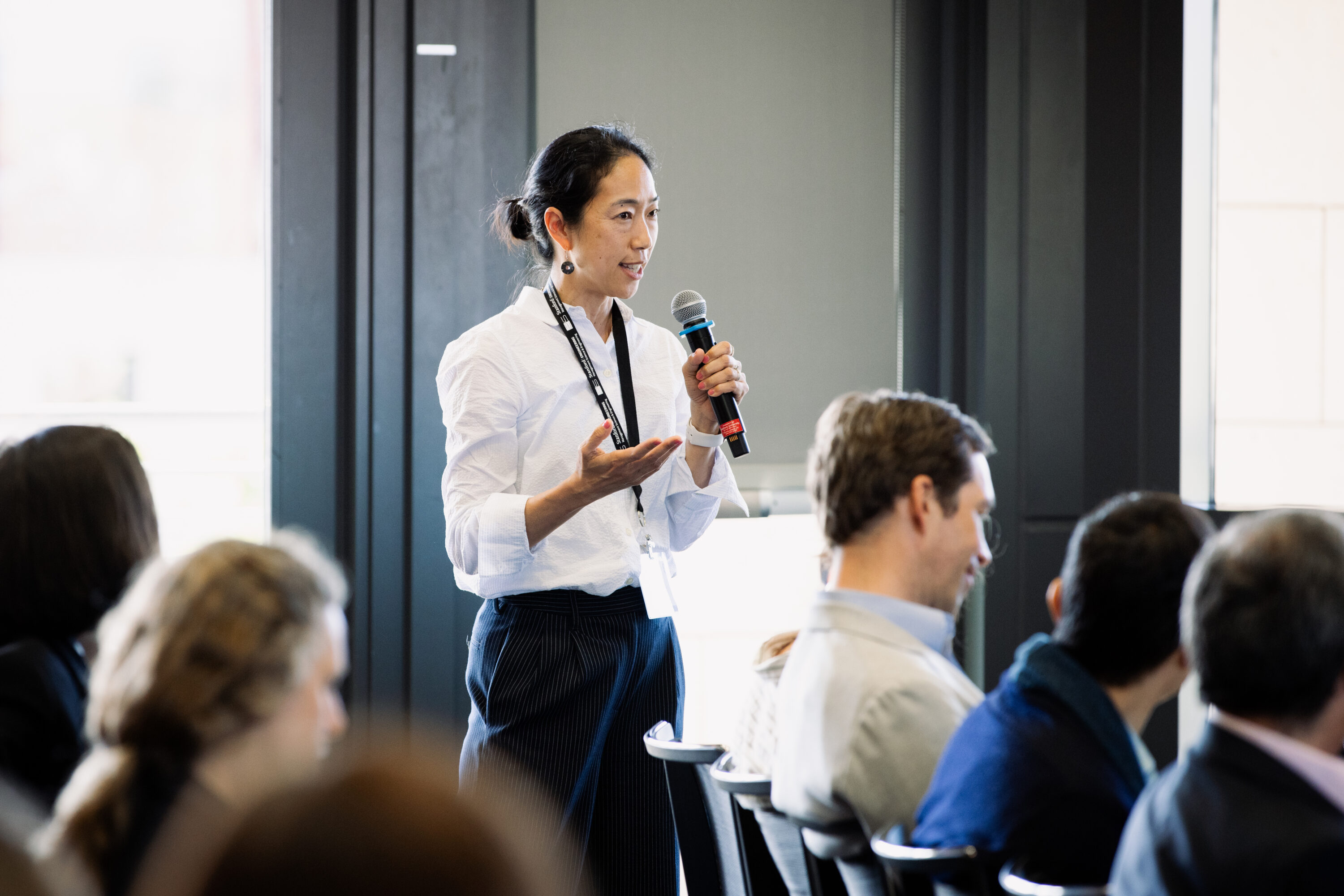
Ann Miura-Ko is a renowned educator and mentor at Stanford University, where she co-teaches the Mayfield Fellows Program (MFP) and lectures in entrepreneurship. With a PhD in math modeling of cybersecurity from Stanford, Ann is celebrated for her hands-on, student-centered approach and for shaping some of the university’s most impactful entrepreneurial courses, including Tech Venture Formation and Lean Launchpad. Beyond Stanford, Ann is a co-founding partner of Floodgate Ventures and serves on the Board of Trustees at Yale University, where she completed her undergraduate studies.
STVP’s Executive Director Ash Wallington caught up with Ann as she reflected on the changes in student pressures, the value of integrity and personal growth, and why universities must better articulate their relevance – especially as entrepreneurial pressures rise.
Ash: Ann, you’ve had a long involvement with Stanford from a teaching perspective. What initially drew you to mentoring entrepreneurs and students, and eventually co-teaching MFP?
Ann: My journey started as a PhD student. I came to Stanford as an older student, with five years of venture capital experience, and my studies let me explore research areas outside my main field as a course assistant. I started out as a CA for MS&E 273, Tech Venture Formation, with Mike Lyons, Audrey MacLean, and Mark Lesley. Since I had more experience than most course assistants, I was given a lot of freedom to share my perspective and challenge aspects of the class I didn’t agree with. I was constantly thinking about ways to improve the class from the student’s point of view. My contribution to Lean Launchpad was born out of this process of thinking and rethinking the classes we were teaching. One thing I wanted to change was that I didn’t want a long writing assignment describing a business plan at the end of the quarter. I felt like the process of learning (found in Steve Blank’s lean methodology) could be better represented through teaching students that while the pitch was important, what was even more important was that learning journey.
In 2008, Tom Byers and Tina Seelig invited me to be a CA for the Mayfield Fellows Program. It was an incredible teaching opportunity, even though it was a big year for me – I was pregnant with my second child and launching a VC firm! I stayed connected with MFP as a mentor and occasionally joined the teaching team, such as in 2013 when Tom Byers was on sabbatical. Around 2019, Tina moved on to Knight-Hennessy Scholars, and I was asked to step in to co-teach, which I’ve held ever since. I just love the students.
Ash: You have a pretty full plate with your commitments as a VC and other board and community roles. When you think about the time you invest in MFP, what drives that commitment?
Ann: I’ve sometimes been accused of loving teaching more than investing, but honestly, I see a lot of synergies between my work as an investor and my role as a teacher, even though in some ways it doesn’t make sense from a time perspective. To be clear, it is not a core deal source and I teach a class that talks many students out of being a founder by giving them the hard facts about what it means to be a founder. However, being so close to students has made me much better at assessing talent before there are concrete proof points.
For one, I don’t need to rely on a resume to spot someone’s potential – sometimes, the person with the perfect resume isn’t impressive in real life, while someone with an imperfect transcript can be truly amazing. You really get sharper at recognizing raw talent very, very early on.
Another benefit is understanding what’s top of mind for students, which is fascinating and directly relevant to my work. And finally, being around students buys me some optimism. Their fresh perspective helps me see things differently and keeps me from becoming jaded. That sense of optimism is actually a critical part of my job.
Ash: How has your own entrepreneurial and VC journey shaped your approach to mentoring?
Ann: Working with students has forced me to explain things I used to take for granted. Especially early on, when we were introducing the Lean Startup Method and building the language around it, I realized people assumed experimentation alone leads to a great startup. But actually, what’s most important is proving that the idea is actually venture scale and not just merely a good idea.. That challenged me to figure out how to clarify for students what “venture scale” means, and what it doesn’t.
Similarly, when explaining how engineering organizations operate today versus how they might change in the future, I needed to bridge the gap. Students are tuned into potential changes, but they don’t always see how companies work right now. So can we work together and explore what the future could look like, and if it makes sense as a future scenario.
Ash: What experience from guiding the programs has stood out the most to you?
Ann: Some of the stand out moments are seeing industry stars taking moments to talk to our students. For example, early on we had an open house at Facebook with Sheryl Sandberg – that really stood out. Even recently, in a site visit to OpenAI, Sam Altman popped in. A lot of those open houses are eye-opening moments.
The second one is darker. When Covid shut everything down as we were getting started with that cohort, we really had to think, “What does it mean to create community?”
Finally, having my students from 3, 8 or even 15 years back come back to update me on their lives and to see the actual impact of Mayfield Fellows program reverberating so many years later in their lives.
Ash: Have you noticed any changes in student mental health and well-being over your time leading the program?
Ann: Students are always carrying a heavy load. I don’t cut them a lot of slack because I don’t think it is any harder – or easier – on them. We always feel like it’s a crazy moment in history or there is lots of pressure, but there always has been.
Yale runs a class called America 250, to celebrate the 250th anniversary of the United States, which I’m following along on YouTube. When reviewing our history you realize, this country has been through some really crazy stuff. Yes, it’s a crazy moment now, but it’s been crazier. The start was even crazy! And it was started by a bunch of 19- to 25-year-olds, who were the entrepreneurs of that generation. These entrepreneurs were politicians, government creators, and philosophers, who also carried a tremendous load. And sure, our current students do, too.
Ash: What do you hope the entrepreneurial and higher education landscape looks like for students 10 years from now?
Ann: Just seeing this on the ground, I think that Stanford, and all universities, are going to increasingly need a story as to why an education is relevant. Especially in an entrepreneurial setting, more and more students – if they are talented – are getting increasing pressure to drop out. And there has to be a more compelling storyline of why they shouldn’t.
I was talking to Stanford star soccer player Naomi Girma about this, because she experienced a lot of pressure to drop out of Stanford and go professional, and she made a very conscious decision not to do that because she felt that her path within a university was a unique moment in time.
A lot of people think, “Oh, it’s just a year,” so a lot of people leave to start their not-great company because there is a lot of money about. You can do your not-great company for 3 to 4 years – and what will you have to show for it? At least at Stanford, you would have an incredible education and entrepreneurial community.
I also believe it’s critical to talk about the value of the humanities, especially at a school rooted in engineering. That’s something unique to Stanford – it’s an important part of what we offer students.
Otherwise, I worry that we’ll just see a wave of gap years and university will become nothing more than a stepping stone to something else.
Ash: If there is one thing you wish students could take with them from your program for the rest of their careers, what would it be?
Ann: I think integrity is the common thread. I’m tough on my students when it comes to integrity – meaning, doing what you say you’re going to do. This includes something as simple as making class a priority and actually showing up. I understand that some of our fellows are working full time while doing MFP, and that’s fine – the agreement is that they can work, but MFP has to come first.
I also think of integrity in the context of being an entrepreneur – in that you are seeking the truth about your startup. You’re trying to show this ought to exist in the world. It’s not about forcing something into existence or paying your way; it’s about proving that people actually want your product, are willing to pay for it, and that it can stand on its own as a profitable business. Too often, I see people let themselves off the hook when it comes to this deeper kind of integrity.
Ash: What’s one piece of advice to other mentors working with students in this space?
Ann: The idea of mentoring a student is that you’re not mentoring a business plan but you are mentoring the whole person. You need to respect their place right now as a student.
Again, there are these voices that say, “You should drop out,” and it is so short sighted. It’s so economic and transactional, versus looking out for what is best for that student.
Now, if a student is sitting on a really great idea, like Mark Zuckerberg with Facebook, that’s one thing. But to tell a student that doesn’t really have an idea that they should drop out – it’s so irresponsible that they shouldn’t be mentoring students. They should want to mentor a student whether the student is the next Even Spiegel or will go on to be an incredible employee in the ecosystem.